
What is a truffle?
The truffle is the fruiting body of an underground fungus of the genus Tuber. Unlike many species of fungi that simply grow on decaying organic matter, the truffle is said to be ectomycorrhizal, meaning that it must be in symbiosis with the roots of a tree in order to thrive.
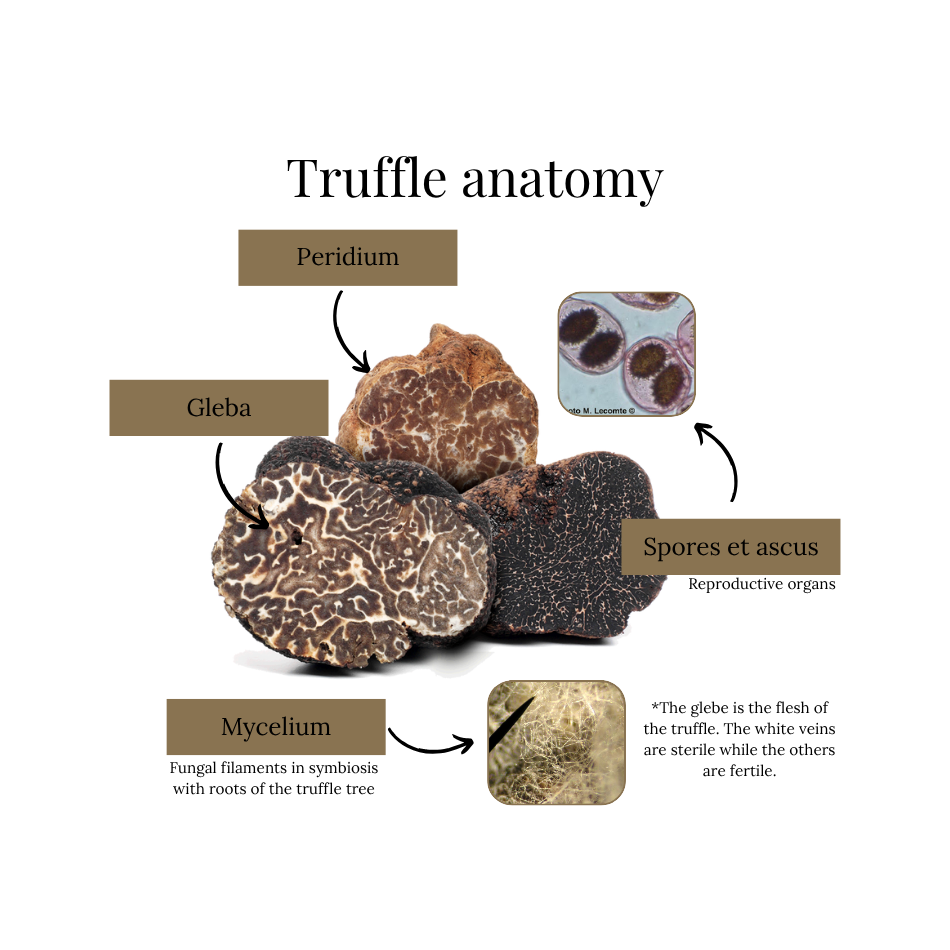
Truffles are made up of several parts, including the mycelium buried underground, the hyphae that make up this network and of course, the ascocarp, the visible part that we savor.
Here, we group truffles into three broad categories: native truffles , naturalized truffles , and European truffles . Discover below the characteristics that distinguish them from each other.
From 1980 to today...
The history of truffles in Quebec
1980: discovery
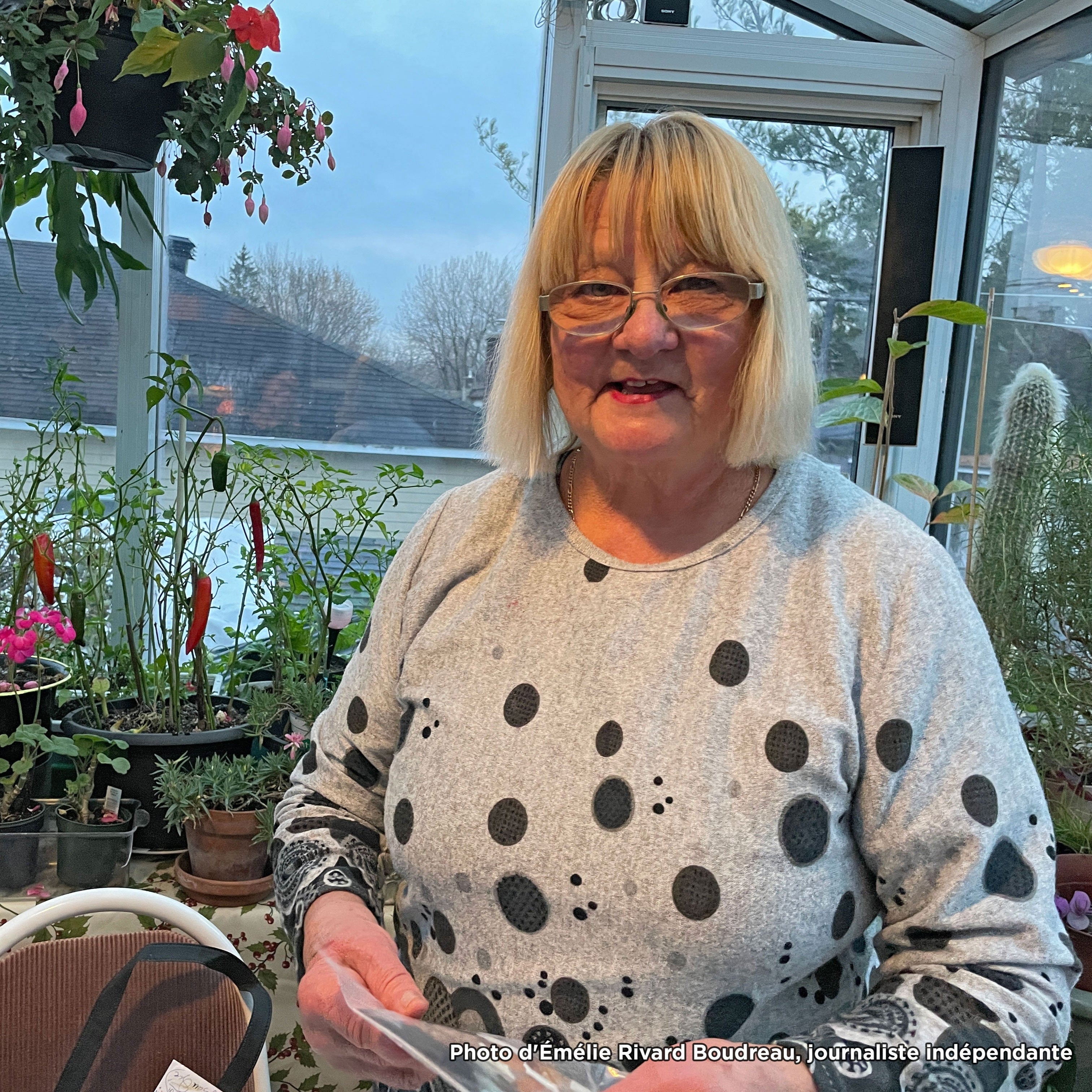
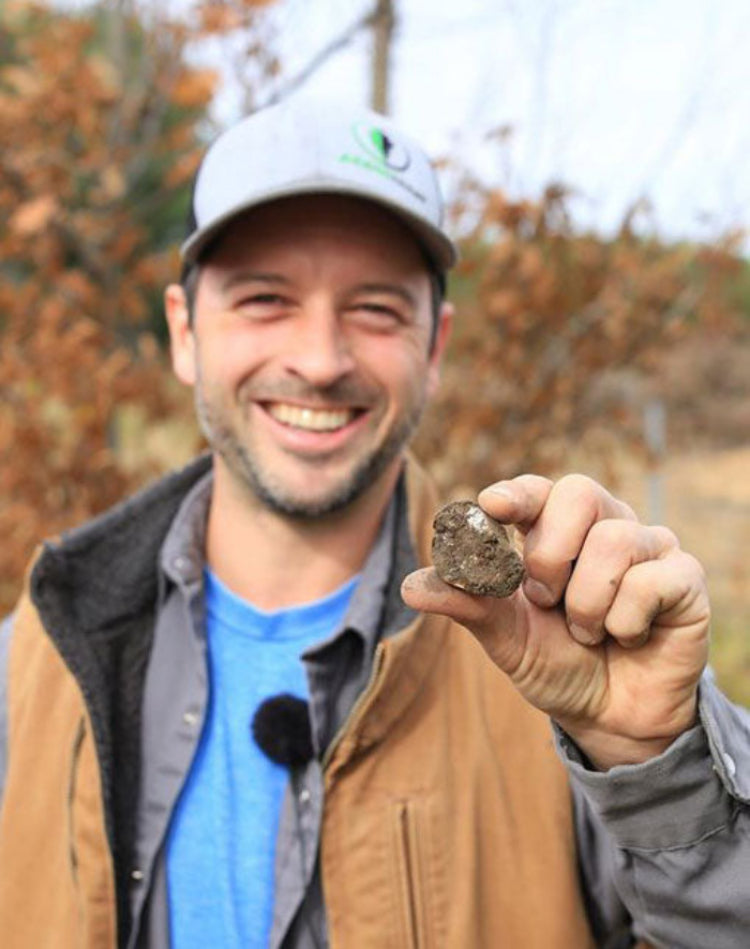
The truffle adventure began in the 1980s with the arrival of Francesca Marzitelli in Quebec. Now a renowned truffle picker, this Argentinian woman was the first to unearth the delicious and precious Quebec truffle, commonly known as the Appalachian truffle.
2009: passion
It was during his studies in microbiology that Jérôme Quirion, co-owner of Truffes Québec and president of AborInnov, began to take a serious interest in truffle cultivation. During an internship in 2009, he discovered the existence of about ten native Quebec truffles, including the Appalachian truffle, a local product with strong commercial and gastronomic potential. Jérôme eventually gave up his master's degree to pursue research and development of truffle plants adapted to the Quebec climate.
2010: research
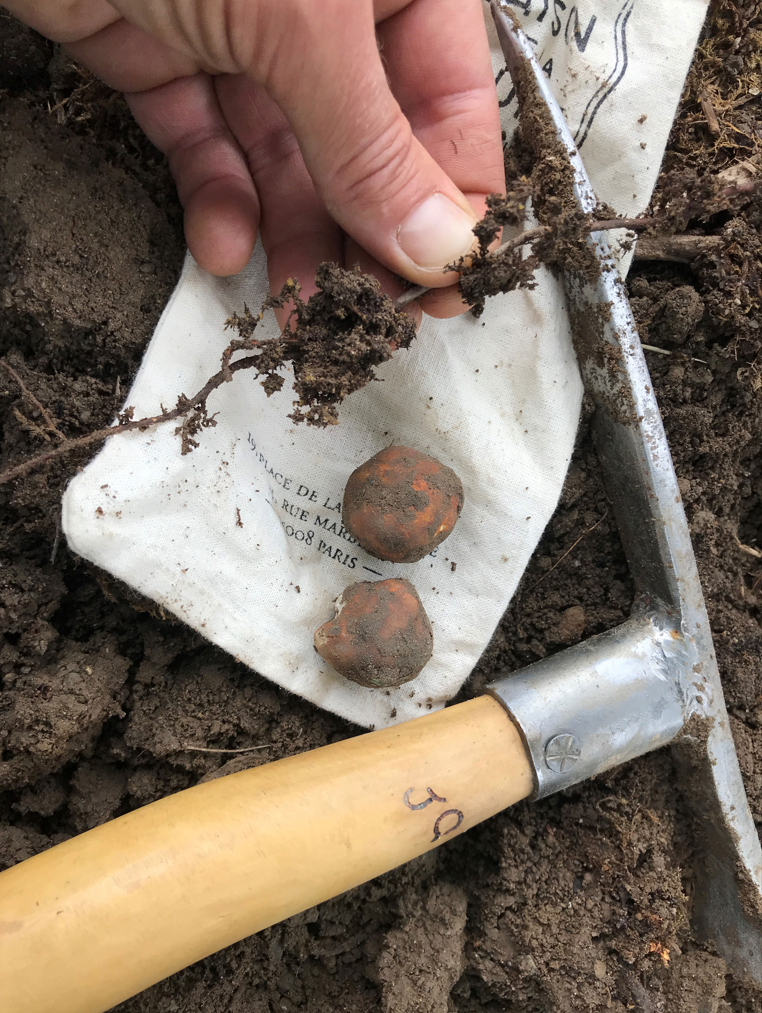
Following his discovery, the biologist planted nearly 2,000 nut trees on a farm in the Sherbrooke region and called upon the expertise of Francesca Marzitelli to obtain the native specimens he needed for his experiments. After seven years of work, he and his team finally found the recipe for establishing the symbiosis necessary for the growth of the Appalachian truffle in the roots of truffle trees. A discovery that would be worth its weight in gold!
“ We are the first in the world to cultivate the Appalachian truffle ” – Jérôme Quirion
2015: democratization
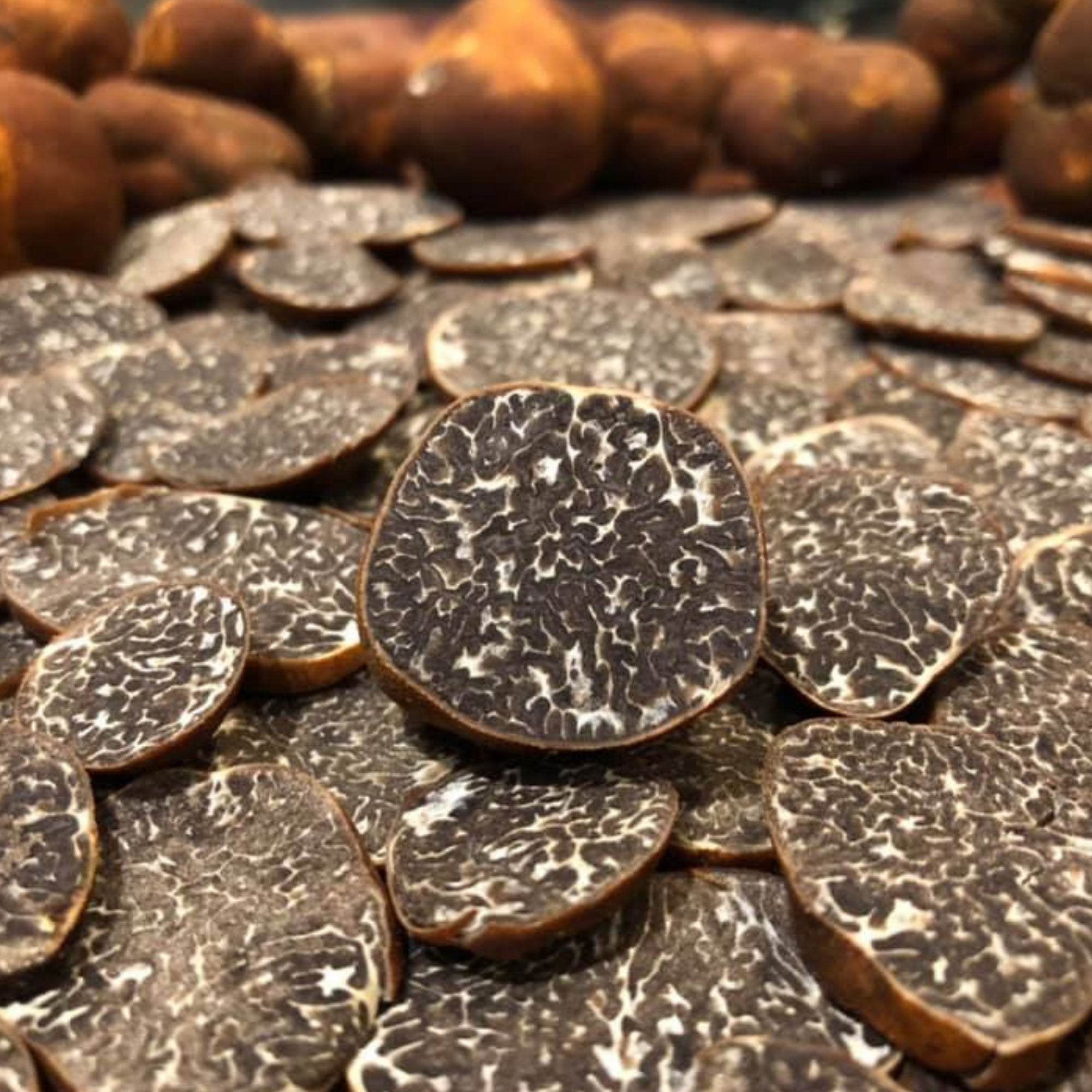
Since 2015, Truffes Québec—born from a partnership between ArborInnov, Jérôme's first company, and then other partners—has been working to propel truffle cultivation in Quebec. Interested producers can now start their own truffle tree plantation in Quebec, thanks to the advice and expertise of our team.
2020: materialization
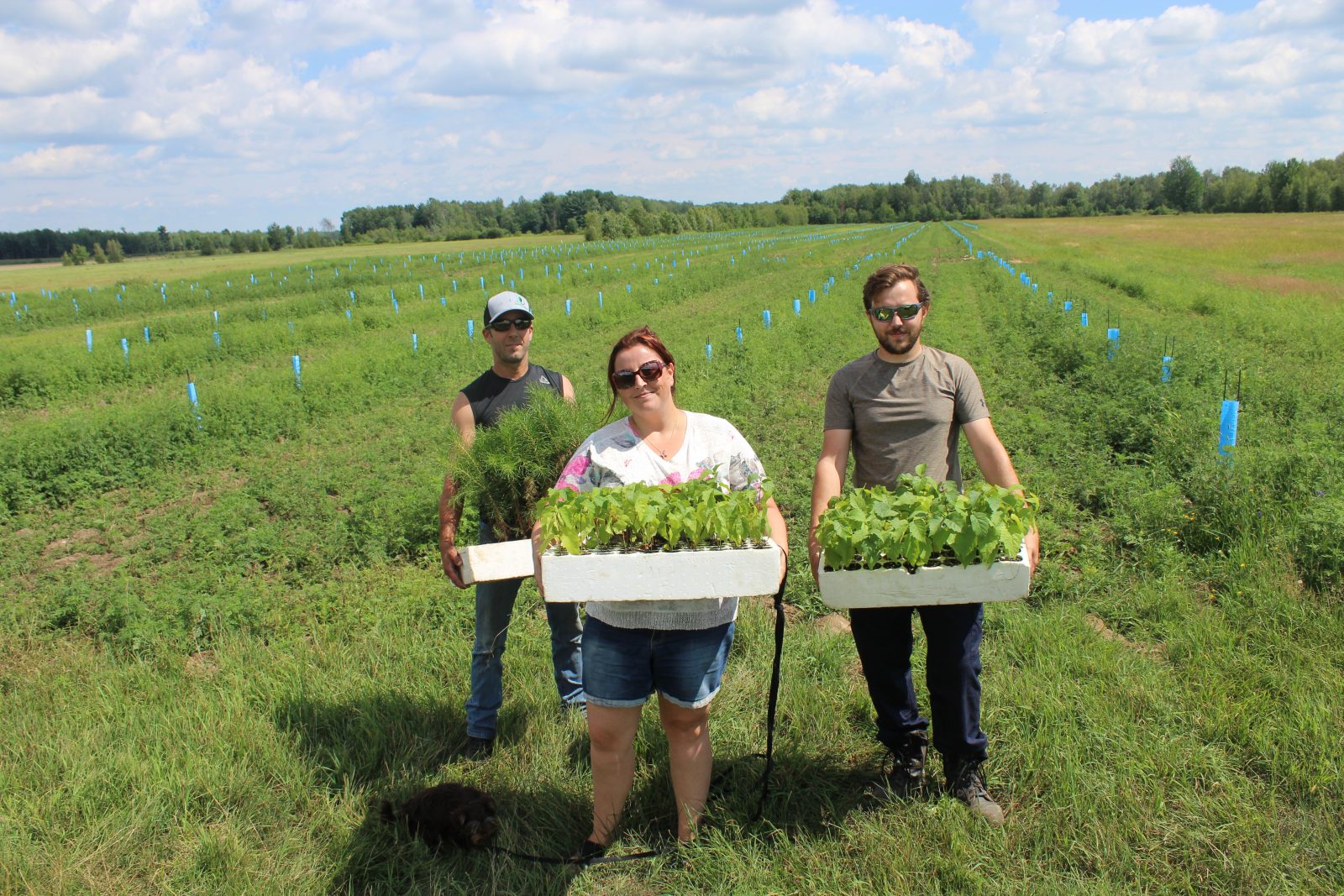
In June 2020, Maude, Jean-Simon and Hugues took the plunge into the world of truffle farming and established the first truffle farm under Truffes Québec, Les Rabassaires , located in Centre-du-Québec! The very first Truffes Québec producer contract was signed on November 19, 2019.
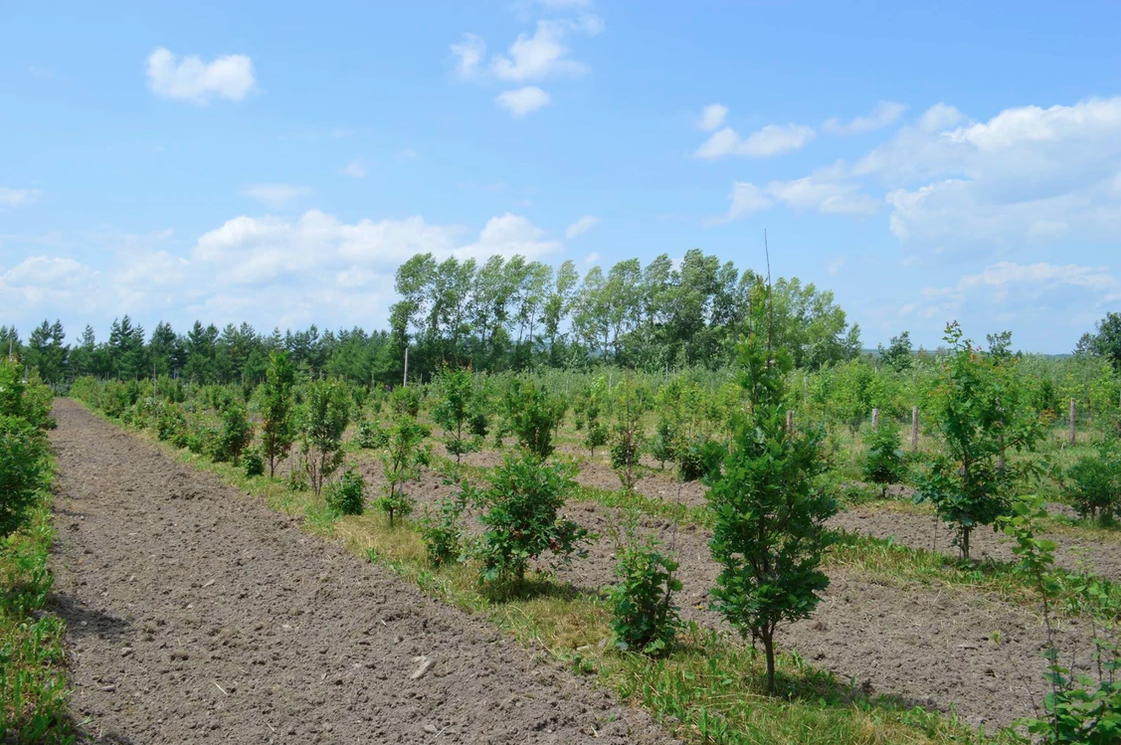
The three entrepreneurs demonstrated inspiring curiosity by daring to embark on this ambitious project. They decided to actively participate in the expansion of the truffle industry in Quebec by planting 1,700 truffle trees on their family farmland. Their project is an inspiring example of perseverance and innovation.
today: growth
Today, Truffes Québec brings together more than 75 producers, nearly 100,000 trees sold, approximately 75 hectares of truffle cultivation and major partnerships with, among others, the Myco Mauricie sector, Kamouraska Mycologique, Biopterre, UQTR and CRIBIQ. We want to continue building an economy based on the promotion of our terroir, the pride of our producers and the sharing of our local culture.
The local truffle is “ A hidden treasure, an unsuspected wealth for our province and a valuable heritage for our children. ” – Maude Lemire Comeau, President and co-owner.
our truffles
Quebec Truffles
Native truffles are species that are naturally found in a specific region. In our case, these truffles are native to North America. They are adapted to the climatic conditions, soils, and ecosystems of our region. Truffles are prized for their unique aromas and flavors, which are often characteristic of the region where they are found. To date, about twenty truffle species are recognized worldwide for their culinary qualities, and our local truffles are just as good!


Our forest queen
the Appalachian truffle
Tuber canaliculatum
Origin and Distribution
The Appalachian truffle is named as such because it is found naturally along the Appalachian mountain range, east of the Rockies, from northern Mexico to southern Quebec. It is an extremely rare truffle, described and discovered in Michigan in 1920, and then in Quebec in the 1980s.
Visual Identification
Nose of a reddish-brown resembling cinnamon, a very distinctive color. Interior pale to dark gray at first, turning blackish-gray to black when fully mature. Firm texture. It measures from 2 to 11 centimeters.
Aroma and flavor
Its aroma is characterized by moderate intensity with woody and earthy notes, complemented by slightly sweet accents reminiscent of dried fruit or cocoa. Sometimes alliacious and cabbage notes. The Appalachian truffle offers a delicate and balanced taste, with hazelnut flavors and wild mushrooms
It is perfect for flavoring risotto, pasta or eggs. While waiting to be able to taste it fresh, discover its flavor through our Les Truffettes products!
Ideal habitat
Young forest with semi-open canopy or mature forest with closed canopy. Prefers sandy or gravelly soils, thus well-drained, but with constant humidity, in mixed forests.
Preference for hickories (Carya), hornbeams (Carpinus), hazelnuts (Corylus), pines (Pinus), chestnuts (Castanea), spruces (Picea), beeches (Fagus), hemlocks (Tsuga), willows (Salix), lindens (Tilia), and oaks (Quercus).
pH: 6.7 to 7.7
Organic matter: 5 to 10% - The Appalachian truffle thrives in well-structured soil with a high organic matter content.
Soil texture: S, S-L, L-S, L-S-A, L, L-Li
Harvest period
From September to November, potentially extending to January.
Slower establishment phase, secondary and tertiary succession truffle. First harvest expected 7 to 10 years after planting, at high density (may be longer if planted at low density).


Little-known, but astonishing
pecan truffles
Rufum Clade: Tuber lyonii, Tuber rugosum, Tuber exuvialis
Origin and Distribution
Native to the American Midwest, pecan truffles are a group of indigenous truffles, some of which are cultivated.
Tuber lyonii is found mainly in southeastern North America but has been reported throughout the East, from Quebec to northern Mexico, with a strong presence in Georgia and Florida.
Tuber rugosum naturally extends throughout northeastern North America, from Michigan and Minnesota to Quebec.
Visual identification
Lyonii: Beige to pale brown with a smooth surface. Marbled interior, beige to dark brown when mature. Size 2 to 7 cm.
Rugosum: Yellowish beige, turning brownish beige when mature. Surface with very rough areas and tight folds. Size 2 to 6 cm.
Exuvialis: Light brown to dark reddish-brown, smooth, relatively bare surface, with slightly rough, orange-brown areas. White and cream interior when young, then marbled grayish-beige, brown when mature. Size 2 to 4 cm.
Aroma and taste
Lyonii: Mild to moderate aroma, earthy and woody, sometimes smoky; delicate and buttery taste, slightly sweet, with notes of toasted hazelnut, wild mushroom, and damp earth.
Rugosum: Moderate to strong aroma. Alliaceous notes reminiscent of Italian white truffles, slightly smoky, almost pungent, also almond and India ink when mature. Complex flavor on the palate.
Exuvialis: Powerful and complex aroma, marked by smoky, almost pungent notes, reminiscent of smoked sausage and vanilla. Smoky and sweet flavors that intensify the intense olfactory experience.
Ideal Habitat
Typically found in pecan orchards, agroforestry parks, forest edges, or open oak and hickory forests, but also under pines and hazelnuts. Often in urban and disturbed environments where young deciduous stands are observed. Thrive in young forests with open to semi-open canopies.
pH: 6.5 to 7.9
Organic matter: 1 to 7%
Soil texture: SL, SCL, SCL, SL, CL, L
Harvesting period
Harvest from mid-August to mid-November, potentially extending until January.
Rapid establishment phase, primary and secondary succession truffle. First harvest expected between 4 and 7 years after planting.
Truffles from Europe
These truffles below originate from Europe. They are renowned worldwide and are highly prized in gastronomy, considered luxury ingredients. They are often imported from other countries for cultivation. We can then speak of naturalized truffles, species that have been introduced into a specific region where they are not native. These truffles can be successfully cultivated in regions that offer conditions similar to those of their original habitat, which is why they can be grown in Quebec!


Cousin of the white Alba truffle
the Bianchetto truffle
Tuber borchii
Origin and Distribution
European species, vast territory from Finland to Sicily and from Ireland to Hungary.
Visual identification
Slightly velvety and white at first. When mature, smooth, reddish-ochre surface with brown markings. Puberulent to smooth, without warts. Whitish inside when young, becoming light ochre or pinkish-brown when mature. Also brownish to purplish-brown. Veins few, diffuse outline, white to ochraceous. Bianchetto truffles measure 3 to 10 centimeters.
Aroma and flavors
Its aroma is intense and its flavour is moderate. Develops garlicky, mineral, and spicy notes when fully mature. This truffle pairs very well with butter. A little marvel to discover, raw or as a finishing touch to a hot dish.
Ideal habitat
Highly adaptable ecologically. It is frequently found in well-drained, sandy, and calcareous soils, typical of coastal areas.
Young forest with open to semi-open canopy.
Main host trees: Oaks (Quercus), hazels (Corylus), pines (Pinus), hickories (Carya), lindens (Tilia), willows (Salix), birches (Betula), etc.
Ideal pH: 6.5 to 7.5
Organic matter: 0.5 to 5%
Soil texture: S, S-L, L-S, L, L-S-A
Harvest period
Harvest from late November to March, sometimes even in spring, when the snow melts. In Quebec, one might want to call it the snow truffle!
Rapid establishment phase, primary and secondary succession truffle. First harvest expected 4 to 7 years after planting, sometimes sooner.


World-renowned
black truffles
Tuber melanosporum, Tuber brumale var. moschatum, Tuber aestivum/uncinatum
Origin and Distribution
Melanosporum: Native to the Périgord region of France, it is also found in Italy, Spain, Slovenia, and Croatia. It has been successfully introduced to Australia, New Zealand, and North America.
Tuber brumale var. moschatum is a similar species of lesser value (sold 30 to 50% cheaper on the market), also cultivated in Quebec.
Uncinatum/Aestivum*, also known as the Burgundy truffle: Found throughout Europe even Africa, from Sweden to Morocco and from England to Ukraine.
*Tuber aestivum = harvested in summer, immature gleba.
Tuber aestivum var. uncinatum = harvested in autumn, mature gleba.
Visual Identification
Melanosporum: The peridium is black with reddish hues in immature specimens. Covered with pyramidal warts 3 to 5 mm in size. The inside is greyish white at first, then turns black when mature. Compact texture and well-defined white veins. Truffles measuring 3 to 12 cm.
Uncinatum/aestivum: Peridium is blackish-brown to black in color with a warty texture. The inside is white when immature, then beige/brownish at the beginning of its maturity, and finally chocolate brown when fully mature. Very numerous and branched white veins. Firm texture.
Truffles measuring 2 to 10 cm.
Aroma and flavors
Melanosporum: Undertones of undergrowth, strawberries, damp earth or dried fruit, with a hint of cocoa. A slightly pungent and bitter taste, which fully develops after heating.
*As for Tuber brumale, it offers musky and fruity notes; in Europe, it is widely used for processed products due to its lower value compared to Tuber melanosporum.
Uncinatum/aestivum: Medium intense aroma of humus, earthy, fruity and sweet honey notes. Mild hazelnut and honey flavour. Sublime raw in salads, on pasta or to accompany cheeses.
Ideal habitat
Melanosporum: Well-drained, calcium-rich calcareous soils. It is preferentially found on drained plateaus and gentle slopes, with a south, south-east or south-west orientation to benefit from maximum sunlight. Hot climate and mild winter.
Main hosts (non-exhaustive list): oaks and hazelnut trees.
pH: 7.8 to 8.2
Organic matter: 2 to 5%
Soil texture: Sandy loam to clay loam.
_
Uncinatum/aestivum: Thrives in varied habitats, ranging from mature forests to fallow land and old orchards. It also successfully establishes itself in forest reconquest areas, where natural regeneration promotes the emergence of new ecological balances favorable to its fruiting.
Main hosts: Oaks (Quercus), hazelnut trees (Corylus), pines (Pinus), lime trees (Tilia), hornbeams (Carpinus), hop-hornbeams (Ostrya) and beeches (Fagus).
pH: 7.0 to 7.8
Organic matter: 5 to 12%
Soil texture: S, S-L, L-S, L-S-A, L-Li-A, L-Li, L-A, L, A-S, A-Li
Harvest period
Melanosporum (winter truffle): November to February
Primary succession truffle, it prefers forests with open canopies. First harvest expected 4 to 7 years after planting.
_
Aestivum (summer truffle): August/September
Uncinatum (autumn truffle): September to December
Tertiary succession truffle, it takes longer to establish and prefers forests with semi-open or closed canopies, given our Quebec climate. First harvest expected 8 to 14 years after planting